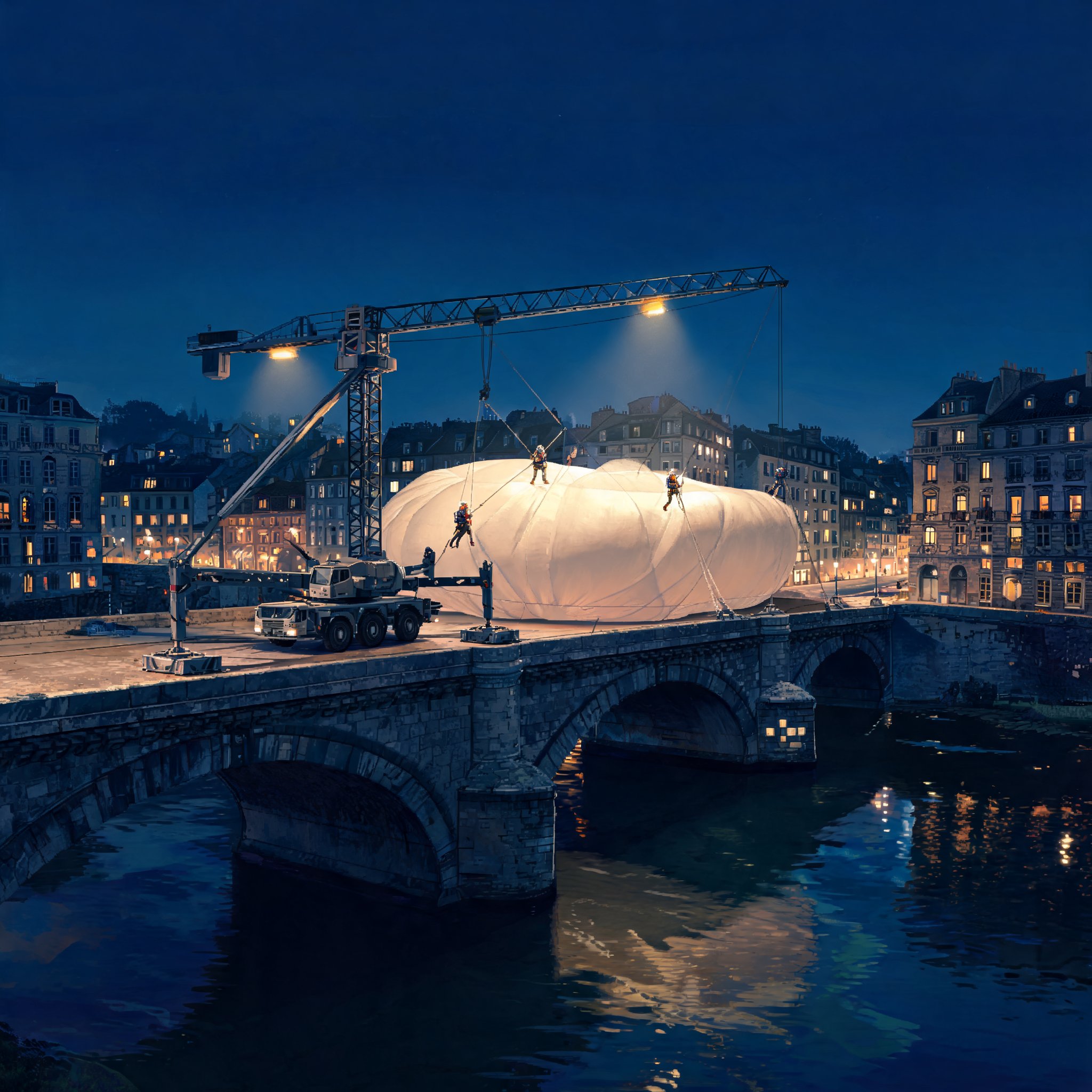
A Liebherr MK 88-4.1 mobile construction crane operated by the Ponticelli group of companies has repaired a historic bridge in central Paris and helped reinstall a damaged art installation. The work took place on the Pont-Neuf, where the crane was used to repair sections of "La Caverne du Pont-Neuf," a temporary artwork by French artist JR.
The installation was created as a tribute to the wrapping of the Pont-Neuf by artists Christo and Jeanne-Claude, first installed in 1985. The inflatable structure is about 120 metres long. In early June, violent gusts of wind and hail damaged parts of its outer shell.
Confined conditions in central Paris
Louis-Arthur de Quatrebarbes, head of the handling and lifting agency at Ponticelli, said the team was on site just a few hours after the damage occurred to work out the best technical solution together with the client. Besides repairing the tarpaulin, the company had to carry out a lifting operation safely in almost constant wind and under considerable time pressure.
The Pont-Neuf, described as the oldest bridge in Paris, offers limited space for work and welcomes a large number of daily visitors. Load-distribution plates were used to reduce ground pressure, while safety and traffic management measures allowed the operation to proceed safely.
Why the MK 88-4.1 was chosen
The team originally planned to use a larger Liebherr mobile crane, but the tight conditions led it to bring in the MK 88-4.1 instead. Its 45-metre trolley jib reached all the damaged areas of the structure. The four-axle design made it easier to relocate the crane from one side of the bridge to the other, where there was also storm damage, while the short set-up time and compact outrigger system further supported the work.
The crane cab could move at working height, giving the operator a clear view of the approximately 18-metre-high structure and the rope access technicians. Boom-mounted spotlights provided illumination of the work area during night-time operations.
Repair over four night shifts
The repair work was carried out over four night shifts. Damaged fabric sections weighing between 200 and 400 kilograms were lifted and reattached in collaboration with rope access technicians. Because the site sits in a wind corridor along the River Seine, weather conditions were monitored continuously, and the crane operator and the rope access technicians stayed in contact by radio.
Before work began, the team carried out site inspections, load calculations and collision analyses of the surrounding buildings. A 360-degree test then confirmed the planned crane positioning.
De Quatrebarbes said Ponticelli was proud to have been part of the work of art, adding that the artist JR has said the installation of the artwork is part of the artwork, and that the crane was too. He described the deployment of the MK crane as visually striking and a magical moment.
According to the company, the project showed the strengths of the MK 88-4.1 in demanding inner-city work where heritage conservation, confined spaces and a high level of precision come together. In such settings, it said, the mobile construction crane combines reach, compactness and flexibility.