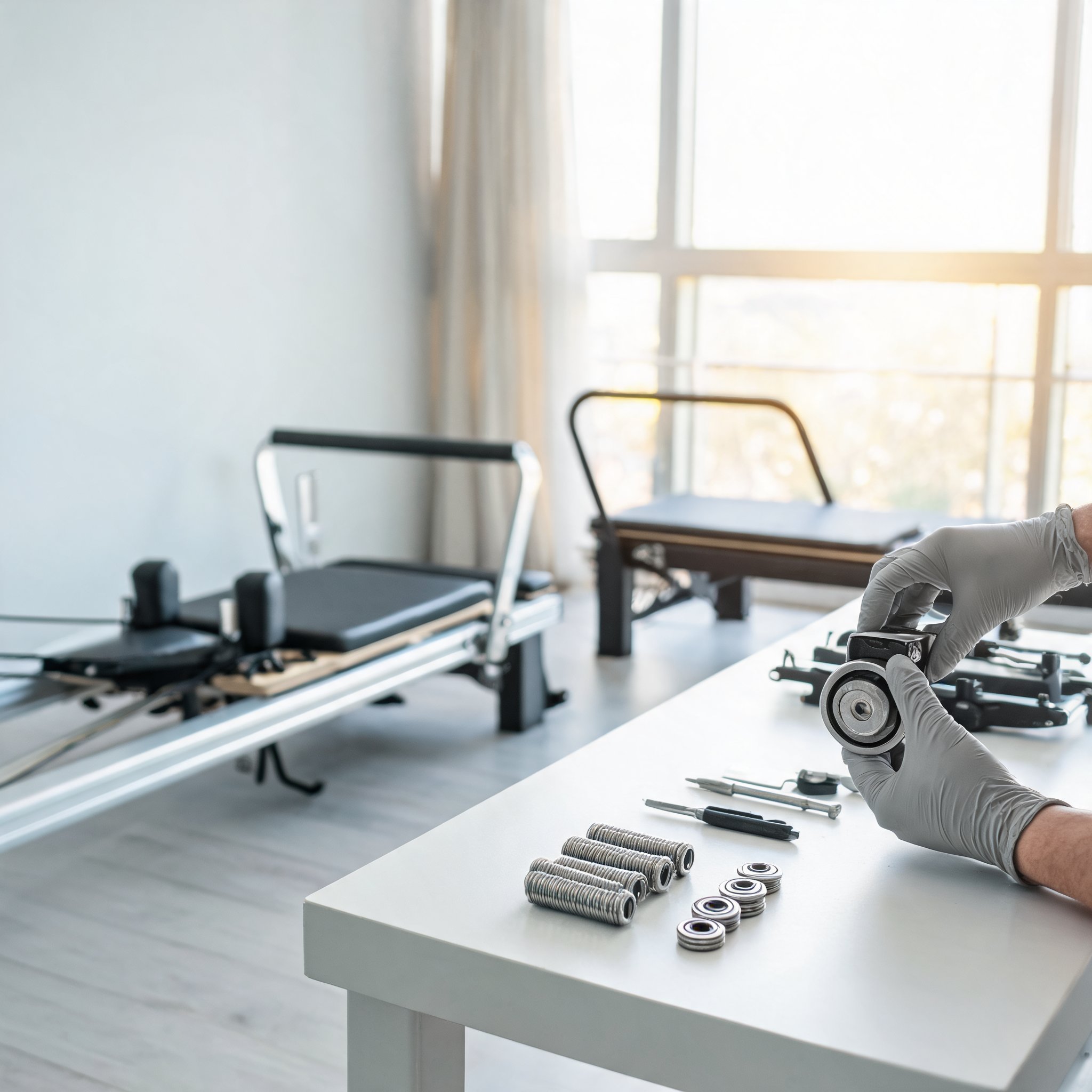
Commercial gym operators and wellness studios are widening their mind-body offerings after major trade gatherings such as FIBO, and demand for commercial Pilates equipment is climbing across Europe, North America and the Asia-Pacific region. Against that backdrop, Shenzhen Ruiteng Sports Technology Co., LTD, which manufactures under the RINTELN name, is presenting its basic aluminium reformer line, including CE-certified models, to overseas studio chains and distributors.
Lightweight but structurally resilient aluminium reformers have become a common choice for modern studio spaces, according to the company. Yet the rise in orders has also exposed a procurement problem: machines that look alike in exhibition halls and on B2B platforms can differ sharply in structural engineering.
A four-point sourcing checklist
The manufacturer argues that buyers should verify technical build parameters rather than surface finishes before issuing purchase orders, and lists four criteria:
- Safety compliance. Verifiable CE certification is described as non-negotiable for commercial operation, given European import rules and commercial insurance requirements covering dynamic load safety and structural integrity.
- Carriage mechanics. Precise linear movement depends on bearings and wheels; generic industrial bearings and unrefined plastic wheels are said to cause audible track friction, uneven gliding resistance and mechanical lag under heavier body weights.
- Spring metallurgy. Low-quality steel springs are said to lose calibrated tension quickly and to risk fatigue during high-extension exercises.
- Supply chain flexibility. Rigid order minimums, restricted frame colours and long lead times can hinder franchise expansion and custom studio concepts.
Faults reported by commercial buyers after deploying low-cost machines in high-traffic studios include noisy carriage tracking, frame deflection under dynamic body loads, premature spring tension fatigue and rapid roller wheel deformation, the company says. Such breakdowns interrupt scheduled group sessions, raise safety concerns and add maintenance cost for facility managers.
Component and carriage engineering
RINTELN, established in 2021, says it integrates German-imported parts into its core structural assembly rather than sourcing generic hardware locally. German-imported springs form the resistance system, and original German sealed bearings are used to minimise rotational friction.
For the carriage, an internal 11-person research team spent 180 days testing material formulations to develop a silent wheel assembly that pairs a high-density, high-tensile polyurethane outer layer with concentric wheel construction. The aim, according to the manufacturer, is to eliminate carriage vibration, floor drag and track noise under maximum load.
The basic aluminium series uses high-grade anodised aluminium profiles and is offered in classic silver and sleek black finishes, positioned for high-traffic group studio environments.
Order terms and after-sales support
The factory sets a one-piece minimum order quantity so international buyers can order an individual evaluation sample and inspect carriage mechanics and structural finishes before committing to bulk orders. Buyers can select from 60 leather colours for upholstery, and the company provides complimentary brand customisation, including laser logos on aluminium frames and embroidery on wristbands and ankle straps. Standard production runs take 7 to 20 days depending on customisation requirements and unit volume.
On total cost of ownership, RINTELN offers a five-year structural warranty and packs high-wear replacement parts alongside initial machine shipments; technical teams supply video tutorials to guide local facility managers through replacement procedures. The durability, component-origin and certification claims described here are the manufacturer's own, and the source material does not include independent test results or third-party verification.