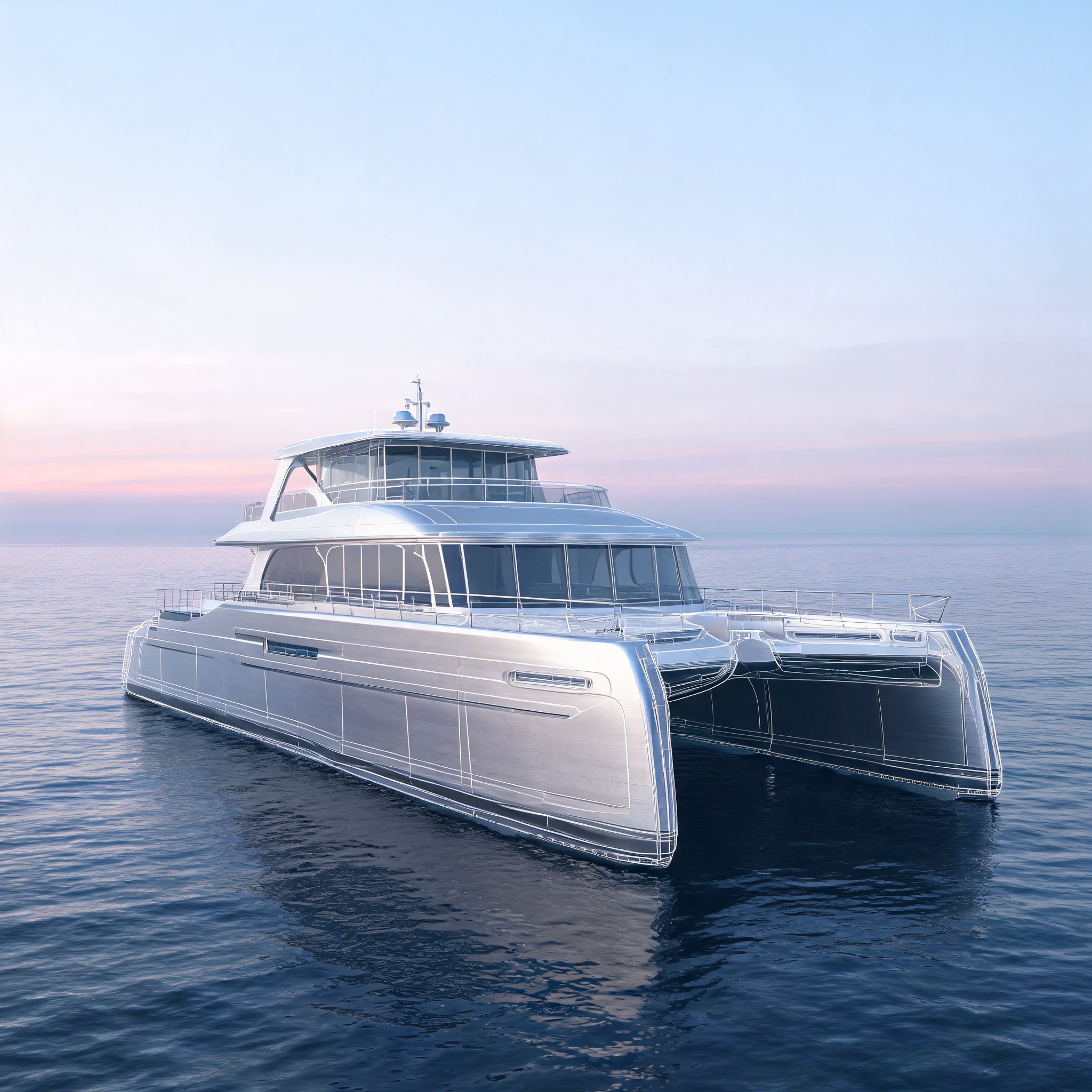
Bering Yachts has presented the first hull of the BC60, an all-aluminium explorer catamaran that has been delivered and is now afloat. The 18.9-metre vessel is the yard's first twin-hull platform, and founder and chief executive Alexei Mikhailov gave a walkthrough of its layout and onboard systems.
The BC60 measures 8.6 metres across the beam and draws 1.58 metres. Bering describes it as a displacement explorer rather than a high-speed production catamaran, with the shallow draft, aluminium hull and fuel capacity intended to support long passages and more autonomous operation at sea. Fuel capacity exceeds 13,500 litres, giving a range of more than 3,500 nautical miles at a cruising speed of 8 knots. Fresh-water capacity is about three cubic metres, while the grey-water and black-water tanks hold 1,500 litres each.
Aluminium hull and two-level engine room
The catamaran applies the yard's explorer approach to a twin-hull layout. Deep sponsons contain a two-level engine-room arrangement that houses generators, watermakers, sewage-treatment equipment and other machinery, while also helping to separate noise and vibration from the living areas. Protected running gear and attention to structural integrity form part of a safety-oriented design approach. The aluminium construction and the resulting weight distribution also allow a fully enclosed flybridge that serves as a second salon.
Accommodation and enclosed flybridge
On the main deck, a salon includes a full helm station with 360-degree visibility, and a galley is arranged on both sides of the space. One hull houses the master cabin, which has room to walk around the bed, panoramic windows, a walk-in wardrobe and an en-suite bathroom with a full shower. The opposite sponson contains two guest cabins, each with its own bathroom. A dedicated crew cabin, laundry and pantry areas, additional refrigeration and extensive storage are also part of the layout, intended to support long stays whether the boat is owner-operated or run by a small professional crew.
The enclosed flybridge has a bar, refrigeration, a day bathroom and 360-degree visibility, and can be arranged as a lounge, gym or office, adding flexibility for life and work at sea.
Range and self-sufficiency
Mikhailov said the yard had taken the range, reliability, quiet running and long-term self-sufficiency it had already demonstrated on its B72 and B88 models and applied them to a catamaran platform. He characterised the BC60 as a displacement exploration machine rather than a leisure catamaran.
Bering positions the combination of a range above 3,500 nautical miles, shallow draft and all-aluminium construction as bringing long-range explorer requirements together with the extra space of a twin-hull platform. The delivery and launch of the first hull mark the point at which the yard's twin-hull explorer concept has moved from design to a floating vessel, extending principles established on the B72 and B88 to a new format.