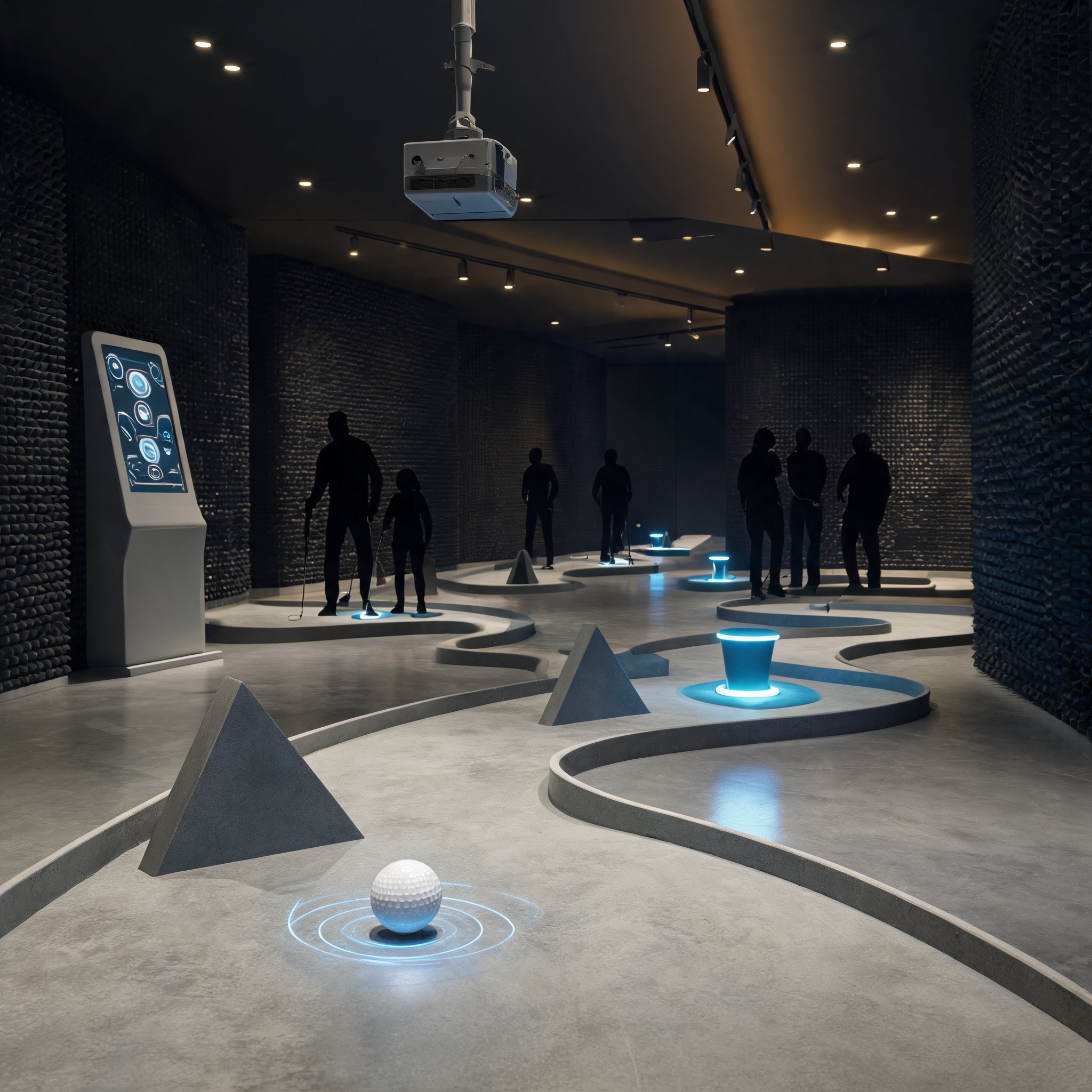
Holovis' 360Golf is best understood not as a new mini-golf concept but as an attempt to turn a familiar leisure format into a connected, measurable game platform. The core experience remains putting, but smart balls, tees and cups plus HoloTrac automated scoring remove paper scorecards and reduce the explanation staff need to give. Visitors register, receive an assigned ball and begin. Holovis executives argue familiarity is an advantage because mini golf already has broad recognition; technology is layered onto that base rather than replacing it. This framing matters to operators weighing whether another competitive-socialising attraction can fill space and generate repeat visits.
The platform's first commercial benefit is operational simplicity. Automated scoring acts as referee and frees staff from scorekeeping; kiosk-based start lets guests understand the game, collect a ball and play without heavy staff involvement. Holovis says the system can handle up to 80 people per hour per course. That throughput claim should be read as a design capacity rather than a guaranteed attendance figure. Still, the logic is clear: if guests can understand the game quickly, labor can shift toward hospitality, food and beverage, and guest management. For venues that depend on service and ancillary sales, that reallocation is part of the commercial case.
Gamification is the second layer. SuperShots offer alternative ways to score; Triumphs provide awards and unlock challenges; bonuses, on-course games, player accounts, achievements, leaderboards and video celebrations give players reasons to compare results and return. These features are not merely decorative. They create a progression system that can turn a one-off social outing into a repeated activity, especially for competitive young adults, families and corporate groups. The risk is that too many layers could confuse casual players, but Holovis says the design goal is sophisticated technology that feels effortless.
DeepSmarts, Holovis' AI analytics engine, extends the platform into operations. It can provide insight into player behavior, seasonality, uptime and potential operational adjustments; it can also help engineers diagnose problems remotely. In principle, this turns each course into a source of feedback. Operators can test promotions in quieter periods, target underused demographics and tune capacity. The value, however, depends on whether venue teams have the time and skills to act on the data. Analytics do not generate revenue by themselves; they inform programming, staffing and promotional decisions.
The commercial promise is strongest where dwell time and secondary spend are central. Holovis says 360Golf is designed to increase both, with capacity and flow intended to support food and beverage sales. At Butlin's Bognor Regis PLAYXPERIENCE, a £15m indoor activity centre that opened in 2024, the tech-putt offer includes three nine-hole courses: a neon-glow course, a Las Vegas-themed challenge and a wheelchair-accessible music-themed course. Holovis reports that in busy weeks the attraction attracts 5,000 players and grosses around £40,000 per week. Those figures are company-reported and venue-specific, but they illustrate the model's ambition: mini golf as an anchor that feeds a wider leisure spend.
Flexibility is central to the strategy. Operators can choose a tech-only retrofit for an existing mini-golf course, standard catalogue holes, or a fully bespoke build. Installation schedules are roughly six to eight weeks for tech-only deployments and eight to 12 weeks for catalogue holes; custom courses can take six months or more. That range lets 360Golf address small venues, multi-site entertainment groups and unusual locations. Norwegian Cruise Line's Tee Time installations, for example, use marine-grade, waterproof equipment and rugged cups, tees and specialist screens. Netflix House's Top 9 course is fully custom and IP-led, with themes including One Piece, Squid Game and Floor is Lava. The same core system travels across very different environments.
Multi-site operators represent another target. Saudi Entertainment Ventures can use the platform to maintain consistency across locations while varying theming, layout or branding. Super Social in Leopardstown, Ireland, uses 12 holes from a sports-themed package. Consistency lowers rollout risk; local variation protects novelty. The platform also supports inclusive design, which Holovis says is nuanced: courses may need to accommodate right- and left-handed play, different putter sizes, wheelchair access and enough spacing between holes. At Butlin's, the team adjusted top caps and tee placement so guests with limited mobility can reach the course. These details are not peripheral; they determine whether a venue can serve the intergenerational audiences it wants.
The model's limits are equally important. Competitive socialising is crowded, and Stuart Edgington, global director of business development, acknowledges it will eventually reach peak saturation. 360Golf's answer is to extend its technology into adjacent formats, including a stroke-counting integration with Roxy Leisure's crazy pool tables. That suggests the longer-term proposition is a game-platform business, not only a mini-golf supplier. Yet expansion depends on finding clients with a clear vision and suitable venues. Customisation takes time and investment; data insights require operational follow-through; and repeat visits depend on course quality, service and operational execution as much as on leaderboards.
For operators, the practical question is not whether automated scoring is novel but whether it improves the economics of a specific site. Holovis' sales process starts with venue constraints, audience focus and commercial modelling: whether the target is Friday-night young adults, families, corporate groups or a mix. That is the right frame. 360Golf's strongest claim is that it can make a familiar activity more measurable, more repeatable and easier to operate. Its weakness would be treating technology as a substitute for a compelling venue proposition. The platform is promising because it builds on mini golf's accessibility; it will succeed only if the surrounding operation turns that accessibility into repeat visits and sustainable spend.